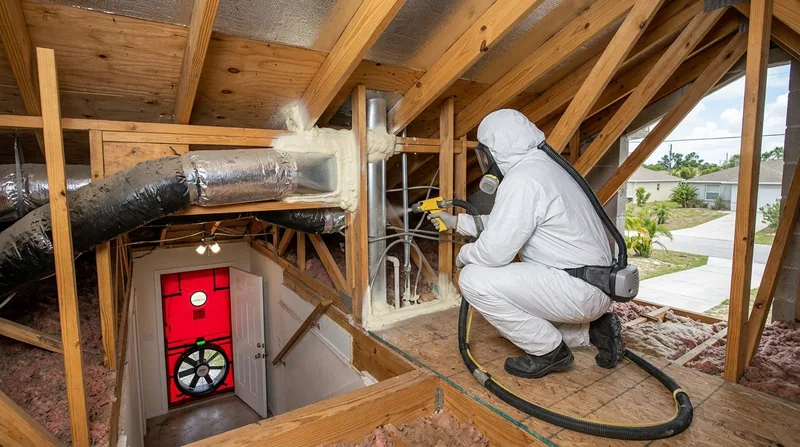




Palm Bay's single-story concrete block homes sit on slab foundations with vented attics that trap heat and humidity year-round in Florida's cooling-dominated climate. The Port Malabar grid that spread across Brevard County from the 1960s onward built a housing stock where ductwork, air handlers, and electrical penetrations run through attics that pull warm, humid Space Coast air straight into the living space through every gap in the top plate, duct boot, and soffit. Air sealing in Palm Bay stops that moisture and heat at the source, cutting the cooling load that drives summer electric bills higher every season. We identify and seal the gaps that fiberglass cannot reach, stopping the humid air that finds its way through block walls and vented attics before it reaches your air handler. The difference shows up on your utility bill and in the comfort of your home.
Why Air Sealing Matters on the Space Coast
Humidity stays high almost all year in Palm Bay, and vapor drive runs from the hot, wet outside toward your air-conditioned interior. Block walls, attic penetrations, and duct boots are where that moist air finds its way in and drives the cooling load that shapes every utility bill in Port Malabar, Bayside Lakes, and Turkey Creek. A vented attic with gaps in the floor and top plate is an open door to the humid air that your air handler has to work harder to remove. Sealing these penetrations before you add insulation cuts the moisture load and makes your cooling system more efficient.
- Seal top plate penetrations and electrical chases before moisture reaches the living space.
- Close duct boot gaps where conditioned air leaks into the unconditioned attic.
- Plug soffit and wall penetrations that pull humid air into the cavity during hurricane season.
- Reduce the cooling load on your air handler by stopping the humidity at the attic floor.
- Protect block walls and rim joists from moisture-driven heat gain in summer months.
Every gap sealed is moisture stopped before it reaches your air handler and your electric meter. For more detail on how spray foam sealing works alongside insulation, see our attic spray foam insulation page.
Key info: Florida's energy code requires that attic ventilation and thermal barriers meet the building code in force at your address. Permitting and registration vary from city to city across Greater Palm Bay. We help you navigate what applies at your location and work with your local building department. Verify any contractor's credentials with your city before signing a contract. More information is available from the Florida Building Code and your local building official.
How We Seal Air Leaks in Palm Bay Attics
Air sealing starts with finding the gaps that fiberglass and blown-in insulation leave open. We walk your attic and identify every penetration, duct boot, top plate gap, and soffit opening where humid air is pulling into the conditioned space. Once we know where the leaks are, we seal them with spray foam or caulk, then add or upgrade insulation on top of a sealed floor. This two-step approach stops moisture before it reaches your air handler and makes your cooling system more efficient.
- Inspect the attic floor and identify all penetrations where humid air enters the living space.
- Seal electrical chases, duct boots, and soffit openings with closed cell spray foam or compatible caulk.
- Tape and seal the seams of ductwork to prevent conditioned air from leaking into the unconditioned attic.
- Close gaps around plumbing vents and HVAC returns before they pull moisture into the cavity.
- Verify the seal with a visual inspection and document the work with photos and thickness measurements.
A sealed attic floor stops the humidity and heat from reaching your air handler. For homes with existing insulation that is settling or has moisture damage, see our insulation removal page to learn how we clear the attic before sealing and re-insulating.
Example: A 1970s block home in Port Malabar with a vented attic and fiberglass insulation has gaps around the duct boots and top plate where humid summer air leaks into the living space. We seal those gaps with spray foam, then add open cell foam on top of the sealed floor. The air handler no longer has to work as hard to remove moisture, and the electric bill drops by 10 to 15 percent in the cooling season. That same home in Melbourne or West Melbourne sees the same result because the climate and the building stock are identical.
Air Sealing Methods and Materials
| Approach | Description | Best for |
|---|---|---|
| Closed Cell Spray Foam | High-density foam that creates an air barrier and vapor barrier in one pass. Sets rigid and provides R-7 per inch. | Top plates, duct boots, soffit penetrations, and rim joists where moisture control is critical. |
| Open Cell Spray Foam | Lower-density foam that seals air leaks and provides sound dampening. Allows vapor transmission. R-3.5 to R-4 per inch. | Attic floor sealing and wall cavities where air sealing is the primary goal and insulation value is secondary. |
| Caulk and Sealant | Polyurethane or silicone caulk for smaller gaps and seams where foam is not practical. Flexible and paintable. | Electrical outlet boxes, small cracks in top plates, and seams in ductwork where access is limited. |
| Foam Board and Tape | Rigid foam board cut to fit around penetrations and sealed with compatible tape. Provides air barrier without spray application. | Duct boots, returns, and large penetrations where spray foam is not needed and thermal barrier is already present. |
The right method depends on the size and location of the gap, the substrate, and whether you need both air sealing and insulation in one step. We specify the approach that stops the leak and fits your budget.
Air Sealing Cost in Palm Bay: What to Expect
Air sealing jobs in Palm Bay typically start at $650 for a small attic with a handful of penetrations and duct boots. The final cost depends on how many gaps need sealing, how large they are, and whether you are sealing only the attic floor or also the rim joist and wall cavities. A full attic sealing job in a 1,500 square foot block home usually runs $1,200 to $2,500, depending on the number of penetrations and how much of the attic floor needs sealing. Getting 2 to 3 estimates from local contractors will show you the range and help you understand what you are paying for.
The cost of air sealing varies with the size of your attic, the number of penetrations, and whether you need foam or caulk or both. A small job with a few duct boots and electrical chases costs less than a full attic sealing with rim joists and soffit work. Access to the attic, the height of the ceiling, and the layout of the ductwork also affect the price. For a detailed breakdown of what air sealing costs in your area, see our pricing page or call us at (321) 341-3084 for a free estimate.
Why get multiple estimates? Because air sealing is a precision job, and the price reflects the contractor's experience, the materials used, and the warranty on the work. A low estimate with no R-value, no thickness spec, and no mechanical ventilation during cure is a red flag. An honest estimate includes the material, the method, the warranty, and a clear explanation of what you are paying for. See our contact page to request a free estimate with written specs.
What to Look for When Hiring an Air Sealing Contractor Near Palm Bay
Hiring the right contractor for air sealing in Palm Bay means checking whether they are fully insured, asking for multiple estimates with written specs, and verifying their references. The trade has rig-and-run crews that spray a job in an afternoon and disappear when the smell will not go away, and it has national franchises that are absent when you need help. A local independent contractor with a local address, local plates, and a track record in your neighborhood is your best bet. Ask any contractor to show you their insurance certificate, provide at least two references from recent jobs in Palm Bay or Melbourne, and explain in writing what the estimate includes and what warranty covers the work.
Getting multiple estimates is smart because it shows you the range of approaches and prices. An honest estimate includes the R-value and thickness of any foam applied, the method used (spray or caulk), the cure time and re-entry window, and a one to three year workmanship warranty. Ask whether the contractor pulls permits and works with your building department. Verify that any contractor you hire carries liability insurance and can show you a current certificate. Check with your city or HOA to see whether air sealing work requires a permit at your address. Call us at (321) 341-3084 to request a free estimate with no obligation to book.
Air Sealing in Palm Bay: Pricing Guide
| Service | Price | Details |
|---|---|---|
| Small attic sealing | Starting at $650 | Sealing 5 to 10 penetrations and duct boots in a 1,200 to 1,500 square foot attic with standard access |
| Full attic sealing with rim joist | Starting at $1,200 | Complete attic floor seal plus rim joist work in a 1,500 to 2,000 square foot block home on slab |
| Attic sealing with insulation upgrade | Starting at $1,800 | Air sealing plus open cell spray foam insulation on the sealed attic floor to R-19 or higher |
| Complex or large-scale air sealing | On estimate | Multiple zones, wall cavities, soffit penetrations, or homes over 2,000 square feet require on-site assessment |
| Travel and estimate | Free | No mileage or travel charge in Palm Bay and surrounding areas. Free estimate within 24 hours at (321) 341-3084 |
Indicative pricing, the exact cost depends on square footage, finish, and site access. Free personalized estimate within 24h at (321) 341-3084.


