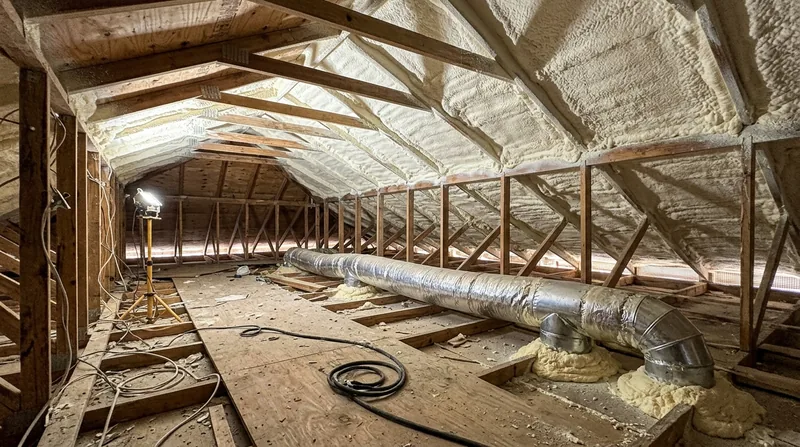




Palm Bay's single-story concrete block homes sit over vented attics that trap summer heat in climate zone 2A, where air conditioning runs nearly year-round and cooling costs track the attic temperature straight upward. These Port Malabar grid homes, built from the 1960s onward across Brevard County, pull humid outside air through every gap in the attic floor, top plate, and duct boot, driving moisture and heat into the living space while the cooling system works against it. Attic spray foam insulation seals those gaps and stops the heat transfer that makes your summer electric bill climb. We spray closed cell foam over the attic floor and seal duct boots and top plates so your air conditioning no longer fights the outdoor temperature above your head. The result is measurable: a tighter attic, lower cooling load, and bills that stay flat instead of spiking with the season.
Why Attic Spray Foam Insulation Matters in Palm Bay's Climate
Port Malabar's vented attic design was standard when these homes were built, but it was never optimized for Florida's cooling-dominated climate. Vapor drive runs from the hot, humid outside toward your air-conditioned interior year-round, pulling moisture through every penetration. In summer, an uninsulated or poorly insulated attic floor lets radiant heat from the roof deck transfer straight down into the living space, forcing your air handler to run longer and harder. Fiberglass batts and blown-in cellulose settle, compress, and leave gaps around ductwork and top plate seams where they were never meant to seal. Spray foam stops both heat transfer and air leakage in a single pass.
- Closed cell foam creates an air barrier and thermal seal that fiberglass cannot match, stopping convection and infiltration simultaneously.
- Sealed attics reduce the cooling load by 15 to 40 percent on average, depending on existing insulation and air leakage points.
- The foam adheres to ductwork, top plates, and roof deck penetrations, sealing gaps that hand-laid batts always miss.
- In Palm Bay's high-humidity climate, the continuous seal prevents humid outside air from being drawn into the attic space and condensing on cooler surfaces.
A properly sealed attic with spray foam stops the root cause of high summer cooling costs in Port Malabar homes: uncontrolled heat and moisture infiltration.
Key info: Palm Bay homes built before 1985 typically have vented attics with fiberglass batts that have settled 2 to 4 inches below the joists. When we spray foam over the attic floor and seal the top plate, we recover R-value lost to compression and close the gaps that fiberglass never sealed in the first place.
For more on how closed cell foam compares to other methods, see our closed cell spray foam insulation page.
You can also verify your local building code requirements through the Brevard County building authority, which oversees energy code compliance for attic insulation in Palm Bay.
How We Seal and Insulate Your Attic in Palm Bay
Our process starts with a visual inspection of the attic floor, top plate, and ductwork to identify air leakage points and measure existing insulation. We photograph the condition and note any moisture, settling, or gaps. Before spraying, we seal larger penetrations around duct boots, soffit vents, and electrical chases with foam or sealant so the spray foam can adhere properly and build to the specified thickness. We then spray closed cell foam at the thickness and R-value specified in your written estimate, working systematically across the attic floor to avoid voids. The foam cures in 24 to 48 hours, and we provide clear guidance on attic re-entry timing and ventilation during cure.
- We inspect the existing insulation and document settling, compression, or moisture before making our recommendation.
- We seal top plates, duct penetrations, and soffit vents with foam or mechanical sealant prior to spray application.
- We spray closed cell foam to your specified R-value and thickness, working in passes no thicker than 2 inches per application.
- We maintain mechanical ventilation during cure and provide a re-entry window of 24 to 48 hours before normal attic use.
- We document the finished R-value, thickness, and coverage in a written report for your records.
This step-by-step approach ensures the foam bonds correctly, cures safely, and delivers the R-value and air seal you paid for.
Example: A 1,400-square-foot attic in Melbourne with settled fiberglass and a vented soffit typically needs top-plate sealing, duct boot closure, and 5 to 6 inches of closed cell foam to reach R-30 and stop the air leakage. We seal the top plate first, spray the floor in two passes, and allow 48 hours for cure before the homeowner re-enters for storage or HVAC maintenance.
For details on air sealing techniques beyond foam application, see our air sealing service page.
Spray Foam Methods and When to Use Each
| Approach | Description | Best for |
|---|---|---|
| Closed Cell Spray Foam | High-density foam at 2 to 3 lbs/cu ft, R-value 6 to 7 per inch, creates a rigid air barrier and moisture barrier. | Attic floors in vented attics, rim joists, and any application where air sealing and moisture control are critical in Florida's humid climate. |
| Open Cell Spray Foam | Lower-density foam at 0.5 to 1 lb/cu ft, R-value 3.5 per inch, provides air sealing and sound dampening with lower cost. | Interior wall cavities where vapor permeability is desired and the application is not exposed to moisture, or budget-conscious attic top-ups where existing insulation is sound. |
| Top-Up Over Existing Fiberglass | Spray 2 to 3 inches of closed cell foam over settled or compressed fiberglass to recover lost R-value and add air sealing. | Attics where removing old insulation is not cost-effective and the existing material is dry and in fair condition. |
| Full Removal and Refoam | Remove all existing insulation, clean the attic floor, seal penetrations, and spray closed cell foam to specification. | Attics with contaminated, water-damaged, or severely settled insulation, or when a sealed attic retrofit is the design goal. |
Attic Spray Foam Insulation Cost in Palm Bay: What to Expect
Attic spray foam insulation in Palm Bay starts at around $1.50 per square foot for a straightforward application over an existing, dry attic floor with minimal penetrations. The total cost depends on several factors specific to your home and attic condition. Attic size is the primary driver: a 1,200-square-foot attic will cost significantly less than a 2,000-square-foot attic. Access and existing insulation also matter. If your attic has settled fiberglass that needs removal, or if the roof deck has many penetrations that require pre-sealing, the cost per square foot moves upward. The R-value target also affects price: achieving R-30 with closed cell foam requires less material than R-38, so your written estimate will specify both the thickness and the R-value so you know exactly what you are paying for.
We always provide a written estimate that names the square footage, the R-value, the foam thickness in inches, and the total price before any work begins. This gives you a clear, comparable number to use when getting quotes from other contractors. For a detailed look at pricing across all our services, see our full pricing overview.
We recommend getting 2 to 3 estimates before committing. Watch for estimates that do not specify R-value and thickness, or that quote a price far below market without explaining why. A contractor who promises immediate re-entry or skips mechanical ventilation during cure is cutting corners that will leave you with a poorly cured foam and potential smell or off-gassing issues. The cheapest estimate is rarely the best value in spray foam work.
What to Look for When Hiring a Spray Foam Insulation Contractor Near Me in Palm Bay
Hiring the right spray foam contractor is the difference between a job that solves your attic problem and one that leaves you with a bad smell, poor curing, or foam that does not bond correctly. The spray foam market includes rig-and-run crews from out of state who spray an attic in an afternoon and disappear, plus national franchises with high overhead, and local independents who stand behind their work. Here is how to evaluate any contractor, including us.
- Confirm that the contractor is fully insured and can provide a current certificate of insurance naming you as additional insured.
- Ask for a written estimate that specifies R-value, thickness in inches, square footage, and total price before any commitment.
- Request references from recent attic jobs in Palm Bay, West Melbourne, or Melbourne, and call at least two to ask about curing time, smell, and whether the contractor was reachable after the job.
- Verify that the contractor will provide mechanical ventilation during cure and a clear re-entry window, never promising immediate occupancy.
- Ask about the contractor's response time for questions or issues after the job, and confirm a phone number and local address.
A local contractor with a local address, local plates, and a track record in Palm Bay is easier to reach and hold accountable than a franchise or a traveling crew.
If you are ready to move forward, contact us for a free, no-obligation estimate. We will inspect your attic, answer your questions, and provide a written spec before any foam is sprayed.
Attic Spray Foam Insulation in Palm Bay: Pricing Guide
| Service | Price | Details |
|---|---|---|
| Attic Spray Foam Insulation (Closed Cell) | Starting at $1.50/sq ft | Includes inspection, top-plate sealing, and closed cell foam to your specified R-value and thickness over existing dry attic floor |
| Top-Up Over Existing Fiberglass | Starting at $1.25/sq ft | Spray 2 to 3 inches of closed cell foam over settled insulation to recover R-value and add air sealing without full removal |
| Full Removal and Refoam | On estimate | Attic insulation removal plus site preparation and full closed cell foam application, cost depends on attic size and contamination level |
| Duct Boot and Top Plate Sealing | Starting at $800 | Pre-spray sealing of major penetrations and air leakage points to ensure foam adhesion and proper air barrier formation |
| Travel and Setup | Included | No additional mileage fee or travel charge for jobs in Palm Bay, West Melbourne, Melbourne, and surrounding Brevard County service areas |
| Free Written Estimate | No charge | Response within 24 hours at (321) 341-3084, includes R-value, thickness, square footage, and total price, no obligation to book |
Indicative pricing, the exact cost depends on square footage, finish, and site access. Free personalized estimate within 24h at (321) 341-3084.


