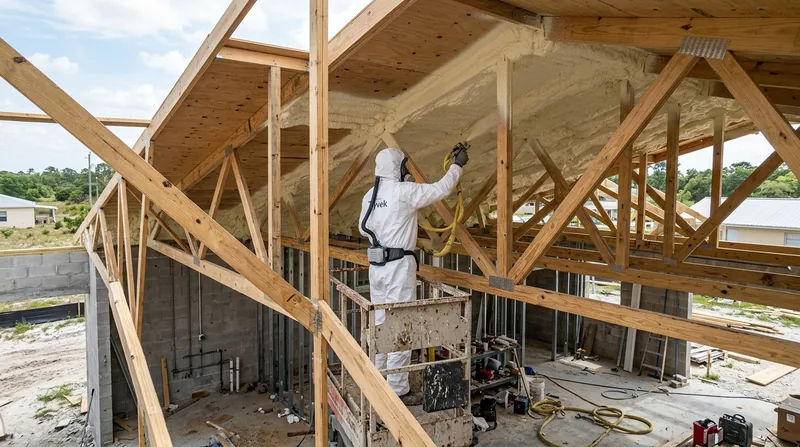




Commercial & New Construction Spray Foam in Palm Bay addresses the cooling load that dominates every utility bill across Brevard County. Small commercial buildings and new construction projects face the same heat and humidity challenge as Palm Bay's single-story block homes: attics and roof decks that trap summer heat, wall assemblies that leak conditioned air, and rim joists where warm, humid air finds its way into the building envelope. The Port Malabar grid and newer subdivisions like Bayside Lakes bring tight framing in some cases, but the slab-on-grade foundation and vented attic layout remain constant. Before the Florida summer arrives, a correctly specified foam system reduces the cooling load that drives operating costs. We quote new construction and retrofit projects, matching closed cell or open cell foam to the roof deck or wall assembly, and air sealing the thermal boundary so the air conditioning stays where it belongs.
Why Commercial & New Construction Spray Foam Matters in Palm Bay's Building Climate
Brevard County's commercial stock and new construction follow the same pattern as residential: cooling-dominated climate, high humidity year-round, and vapor drive that runs from the outside toward the air-conditioned interior. A retail building, office shell, or new warehouse in Palm Bay or West Melbourne loses conditioned air through the attic floor, the rim joist, and every penetration in the top plate and soffit. The cooling season runs nearly twelve months, and every degree of attic temperature above the interior space pulls the compressor runtime upward. A sealed roof deck or an attic floor with continuous closed cell foam eliminates that differential and cuts the cooling load that shapes the operating budget.
- We specify foam type before construction or retrofit, matching closed cell to condensation-prone roof decks and open cell to attic cavities where R-value per inch matters more than vapor permeability.
- We air seal the thermal boundary so no conditioned air escapes through rim joists, top plates, or duct boot penetrations that standard framing leaves open.
- We remove and replace failed insulation in retrofit projects, clearing the substrate so new foam bonds correctly and meets Florida Building Code thermal barrier requirements.
- We help you navigate permitting and code compliance at your address, because requirements vary by city across Greater Palm Bay and there is no reciprocity between jurisdictions.
A building envelope that leaks costs money every month, and a sealed envelope with correct insulation thickness costs less to operate over the life of the structure.
Key info: Bayside Lakes and southwest Palm Bay bring newer construction with tighter framing, but the slab-on-grade foundation and vented attic layout remain the rule. A new retail building or office shell in these subdivisions faces the same cooling load as a 1970s block home in Turkey Creek or Port Malabar. Sealed roof decks and continuous attic floor insulation reduce that load from day one.
For more on the air sealing that protects a building envelope, see our air sealing service page. The Florida Building Code governs thermal barrier and ignition barrier requirements for your project, and the building official at your city determines what applies at your address.
How We Approach Commercial & New Construction Spray Foam in Palm Bay
Every commercial or new construction project starts with a site visit and a conversation about the roof deck or wall assembly, the climate zone, and the cooling load you want to control. We measure the cavity depth, confirm the substrate condition, and specify the foam type and thickness that meets code and performs in your climate. For new construction, we coordinate with the builder and the mechanical contractor so foam is applied at the right stage and mechanical ventilation during cure protects the indoor air quality. For retrofit projects, we remove existing insulation if it is failed, damaged, or undersized, then install new foam at the specified thickness and density.
- We conduct a free commercial estimate on site, measuring the roof deck or wall cavity and noting the substrate condition, existing insulation, and any moisture or thermal issues.
- We specify closed cell foam for sealed roof decks, rim joists, and any assembly where condensation control or high R-value per inch is the priority.
- We specify open cell foam for attic cavities and wall retrofits where the cavity is dry and R-value per dollar is the measure.
- We apply foam at the correct thickness per pass (typically 0.5 to 1.5 inches per pass) so the material cures evenly and reaches full density and R-value.
- We maintain mechanical ventilation during cure and provide a stated re-entry window of twenty-four to forty-eight hours so the building stays safe during the installation.
- We provide a written estimate with R-value and thickness specifications so you know exactly what you are getting and why.
The result is a sealed thermal boundary that reduces the cooling load and protects your operating budget from the day the building is occupied.
Example: A new retail shell in Merritt Island with an uninsulated roof deck and a 1,200-square-foot footprint receives 2 inches of closed cell foam at 3.6 pounds per cubic foot, achieving R-14 per inch and creating a sealed roof deck that stops heat gain and controls humidity. The sealed deck reduces the cooling load by 15 to 25 percent compared to a vented attic with blown-in fiberglass, and the estimate includes the R-value, the thickness, and the basis for the specification.
Learn more about closed cell spray foam and how it controls condensation on metal roof decks and in sealed assemblies.
Commercial & New Construction Spray Foam Installation Methods
| Approach | Description | Best for |
|---|---|---|
| Closed Cell Spray Foam | High-density foam (3.0 to 3.6 pcf) applied to roof decks and sealed wall cavities. R-value is 3.5 to 3.6 per inch. Stops vapor transmission and controls condensation. | Sealed roof decks, metal buildings, rim joists, and any assembly where moisture control is the priority. New construction and retrofit. |
| Open Cell Spray Foam | Lower-density foam (0.5 to 1.5 pcf) applied to attic cavities and interior wall cavities. R-value is 3.2 to 3.7 per inch. Breathable and cost-effective. | Attic insulation, interior wall cavities, and sound dampening. Retrofit projects where the cavity is dry and R-value per dollar is the measure. |
| Insulation Removal and Replacement | We remove failed, damaged, or undersized insulation before applying new foam. Substrate is cleaned and inspected for moisture or thermal issues. | Retrofit projects where existing insulation is compromised or where the building envelope needs to be sealed and re-insulated. |
| Air Sealing with Foam | Foam applied around penetrations, rim joists, top plates, and duct boots to eliminate air leaks. Reduces the cooling load by stopping conditioned air escape. | New construction and retrofit. Any project where the thermal boundary needs to be continuous and airtight. |
Commercial & New Construction Spray Foam Cost in Palm Bay: What to Expect
The cost of commercial and new construction spray foam depends on the roof deck or wall assembly, the foam type, the thickness required by code and climate, and the size of the project. A new retail shell or office building in Palm Bay or West Melbourne with a 1,500-square-foot roof deck and 2 inches of closed cell foam runs differently than a warehouse retrofit with 1,000 square feet of wall cavity and open cell foam. We provide a free commercial estimate on site, measuring the assembly and specifying the foam type and thickness so you know the cost basis before we begin.
Factors that affect the cost include the roof deck or wall cavity depth, the condition of the substrate (if foam is going over existing insulation or a wet surface, we fix the moisture first or we walk away), access to the roof or wall cavity, and the location within our service area. A sealed roof deck on a new construction project in Merritt Island or Cocoa Beach costs less per square foot than a retrofit of a 1970s block building in Port Malabar where the roof is vented and the attic is cluttered. Two to three estimates from qualified contractors give you a realistic comparison and help you understand why the lowest bid is often the wrong choice.
For a realistic breakdown of what drives the cost, see our pricing page. Call us at (321) 341-3084 for a free estimate with R-value and thickness specifications, no obligation to book.
What to Look for When Hiring a Commercial & New Construction Spray Foam Contractor Near Me in Palm Bay
The spray foam trade has two categories of players: rig-and-run crews who trailer in from out of state, spray a job in an afternoon, and disappear when the smell will not go away or the foam shrinks, and local independent shops and national franchises that stake their reputation on the work. The difference shows in the estimate, the installation, and what happens after. A qualified contractor provides a written estimate with R-value and thickness specifications, maintains mechanical ventilation during cure, respects the re-entry window, and stays reachable if questions arise. Before you sign a contract, verify that the contractor is fully insured, ask to see the insurance certificate, check references from recent projects, and understand what the warranty covers.
Permitting for spray foam insulation varies by city across Greater Palm Bay. Some jurisdictions require a permit for new construction insulation, others do not. Some require a thermal barrier inspection before drywall goes up. The local building department at your address determines what applies, and a qualified contractor knows the rules and helps you navigate them. If your project is in an HOA-governed community, check whether architectural approval is required for any exterior work. Ask the contractor how they handle the substrate if it is wet or contaminated, and listen for the answer: a contractor who says they will spray over a wet surface or a roof leak is not the one to hire.
Get a free estimate from Palm Bay Spray Foam Insulation and ask about recent projects in your area, insurance coverage, and the warranty on workmanship. A local contractor with a local address and local plates is accountable to the community and to the building officials who inspect the work.
Commercial & New Construction Spray Foam in Palm Bay: Pricing Guide
| Service | Price | Details |
|---|---|---|
| Free Commercial Estimate | Free | On-site measurement, substrate inspection, foam type and thickness specification, R-value documentation, no obligation to book |
| Closed Cell Spray Foam (sealed roof deck or rim joist) | Starting at $1.50 to $2.50 per board foot | High-density foam for condensation control, typically 2 to 3 inches, sealed assemblies, new construction and retrofit |
| Open Cell Spray Foam (attic or interior wall cavity) | Starting at $0.75 to $1.25 per board foot | Lower-density foam for cost-effective R-value, typically 5 to 8 inches, dry cavities, retrofit and new construction |
| Insulation Removal and Replacement | On estimate | Cost depends on volume, substrate condition, and disposal requirements, included in retrofit project pricing after substrate is assessed |
| Travel and Site Access | Included | No separate mileage fee or travel charge in Palm Bay and surrounding Brevard County service areas |
Indicative pricing, the exact cost depends on square footage, finish, and site access. Free personalized estimate within 24h at (321) 341-3084.


