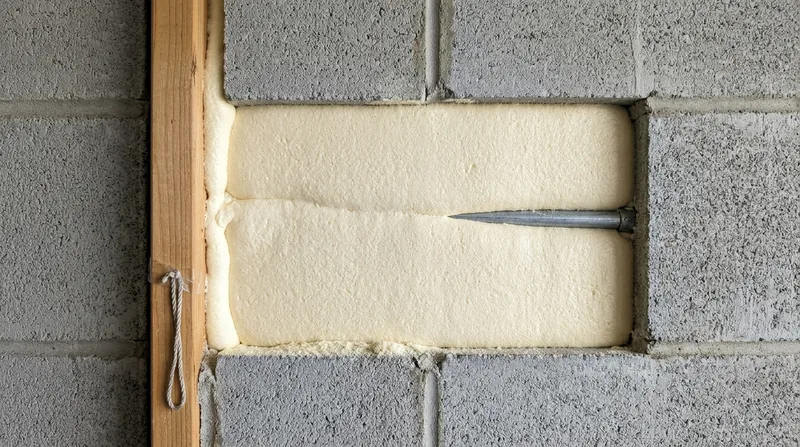




Closed cell spray foam insulation in Palm Bay addresses the core cooling challenge facing the Space Coast: humid air that pushes relentlessly into block walls and vented attics, driving up AC load and electric bills from June through October and beyond. Palm Bay's residential stock is overwhelmingly single-story concrete block on slab, built across the Port Malabar grid starting in the 1960s, with ductwork and air handlers routed through vented attics where summer temperatures routinely exceed 140 degrees Fahrenheit. Vapor drive runs inward from the hot, humid exterior toward the air-conditioned living space below, and every gap in the attic floor, every penetration around the top plate, and every soft spot in the rim joist becomes a pathway for moist air and heat loss. Closed cell foam resists that humid air, adds structural rigidity to rim joists and garage walls, and when installed correctly with proper thickness and mechanical ventilation during cure, delivers the air sealing and moisture control that block homes need to stay cool and dry.
Why Closed Cell Spray Foam Insulation Matters in Palm Bay's Hot, Humid Climate
Palm Bay sits in climate zone 2A, a hot, humid, cooling-dominated region where air conditioning runs nearly year-round. The concrete block construction that dominates the city's housing stock is porous and allows moisture migration, especially where attic floor penetrations, duct boots, and rim joists create discontinuities in the thermal and moisture envelope. Closed cell foam fills these gaps completely, resists vapor drive, and maintains its R-value under the high-humidity conditions that plague the Space Coast from late spring through early fall. Bayside Lakes, Turkey Creek, and older Port Malabar neighborhoods all share the same vulnerability: block walls without cavity insulation, vented attics that trap heat, and slab-on-grade foundations that offer no basement or crawl space buffer.
- Closed cell foam achieves R-6 per inch, resisting the humid air that pushes into block walls and attics across Palm Bay.
- The foam's closed structure blocks moisture migration, preventing the mold and material degradation that open cell foam cannot withstand in Florida's climate.
- Rigid closed cell foam adds structural support to rim joists, garage walls, and roof decks, especially in wind-driven hurricane seasons from June through November.
- Proper installation with controlled thickness and mechanical ventilation during cure prevents off-gassing complaints and ensures code compliance with local building departments.
- A single closed cell application seals air leaks, insulates, and adds rigidity in one pass, reducing labor and material costs compared to layered systems.
These factors combine to make closed cell spray foam the technical solution for Palm Bay's block homes, metal buildings, and garages where moisture control and air sealing are non-negotiable.
Key info: Florida's building code requires a fifteen-minute thermal barrier between foam and occupied space in attics and walls. Ignition barriers and ventilation requirements vary by city and building official. Always verify what applies at your address with your local building department before any estimate is finalized. We help you navigate what applies, but the final determination rests with the official at your location.
How We Install Closed Cell Spray Foam Insulation in Palm Bay Homes and Garages
Our process starts with a site inspection to identify air leaks, moisture sources, and existing insulation condition. We remove failed or degraded insulation if needed, verify substrate moisture, and confirm mechanical ventilation is in place for the cure window. Closed cell foam is sprayed in controlled passes at the manufacturer's specified ratio and drum temperature, built to the exact thickness required for your R-value target. Mechanical ventilation runs during application and for twenty-four to forty-eight hours after, depending on ambient conditions and foam type. Once cured, the foam is trimmed flush to framing and any required thermal barrier is installed per local code.
- We inspect the attic or wall cavity, test for moisture, and verify ductwork and electrical systems are clear of the spray zone.
- Existing insulation is removed and disposed of properly, leaving a clean substrate for foam adhesion.
- Foam is sprayed in layers, each pass built to thickness and allowed to rise fully before the next application.
- Mechanical ventilation is maintained throughout cure and for the full re-entry window specified by the manufacturer and your local code.
- We trim foam flush to the top plate or rim joist and install any required thermal barrier material before the job is signed off.
This step-by-step approach ensures no voids, no over-spray into conditioned space, and full compliance with local code and manufacturer specifications.
Example: A Port Malabar home with a vented attic and degraded fiberglass insulation gets a closed cell retrofit to 5.5 inches (R-33), sealing the rim joist and attic floor penetrations around HVAC ducts and electrical boots. Mechanical ventilation runs for forty-eight hours post-spray. Cost runs from $1.20 to $1.50 per board foot depending on attic access and substrate condition. See our attic spray foam insulation page for more detail on this common application.
Closed Cell Spray Foam Methods and Applications
| Approach | Description | Best for |
|---|---|---|
| Attic floor closed cell retrofit | Foam sprayed to 5.5 to 6.5 inches on the attic floor, sealing all penetrations and rim joists in one pass. | Vented attics in Palm Bay block homes; reduces cooling load and eliminates air leaks around ducts and electrical. |
| Sealed roof deck closed cell | Foam sprayed to roof decking, converting a vented attic to a sealed, conditioned space with no ventilation required. | New construction and major remodels; highest cost but eliminates attic temperature swings and duct losses. |
| Rim and band joist closed cell | Foam sprayed to rim joists and band joists, sealing the slab-to-wall interface and blocking humid air intrusion. | Bayside Lakes, Turkey Creek, and Port Malabar homes; small ticket but critical for moisture control at the foundation. |
| Garage wall and ceiling closed cell | Foam sprayed to garage walls and ceiling, improving thermal separation from the garage to conditioned living space. | Attached garages in Palm Bay; reduces heat and humidity transfer to living spaces and improves structural rigidity. |
| Metal building and barndominium closed cell | Foam sprayed to interior metal walls and roof, preventing condensation on cold metal surfaces and creating thermal control. | Metal buildings, barndominiums, and agricultural structures across Brevard County; closed cell is the only product that stops condensation on steel. |
| Wall cavity and injection foam retrofit | Closed cell injected into existing wall cavities without demolition, filling voids in block or frame construction. | Pre-1980 block homes and frame construction in Melbourne, West Melbourne, and Indialantic; adds R-value without opening walls. |
Closed Cell Spray Foam Insulation Cost in Palm Bay: What to Expect
Closed cell spray foam in Palm Bay typically starts at $1.20 per board foot and ranges up to $1.50 or more depending on attic access, existing insulation removal, substrate condition, and local labor costs. A typical 1,500-square-foot attic retrofit with 5.5 inches of closed cell foam (R-33) runs approximately 8,250 board feet and costs between $9,900 and $12,375 before any thermal barrier material or specialized work. Rim joist and garage applications are smaller in scope and run from $2,000 to $5,000 depending on linear footage and access. Metal buildings and commercial shells are priced on board feet and complexity. The key factors that move cost up or down are attic access, whether existing insulation must be removed, substrate moisture and cleanliness, and local code requirements for thermal barrier and ventilation.
Getting two or three written estimates is essential. Each estimate should specify R-value, foam thickness in inches, total board feet, and whether removal, thermal barrier, and ventilation are included. Estimates with no thickness specification, no R-value, and no breakdown of scope are a red flag. Visit our pricing overview for typical ranges across all our services, and call (321) 341-3084 for a free, no-obligation estimate at your address.
Closed Cell Spray Foam Insulation Near Me: What Palm Bay Homeowners Should Know When Hiring a Contractor
Hiring the right spray foam contractor is as important as the product choice itself. Poor installation, inadequate ventilation during cure, and missing thermal barriers are the most common complaints, and they are all preventable with the right contractor and clear communication. Before signing any agreement, verify that your contractor is fully insured, has references you can call, and pulls the permits that your local building department requires. Confirm that your estimate includes written specifications for R-value, thickness, and any thermal barrier material. Ask about the re-entry window and mechanical ventilation plan. If you have an HOA, check whether exterior work or metal building insulation requires architectural approval. Most importantly, choose a contractor who will walk away from a wet, contaminated, or leaking substrate rather than spray over it and create a bigger problem later.
- Verify that the contractor is fully insured and can provide a certificate of insurance before work begins.
- Request references from recent jobs in Palm Bay, West Melbourne, or Melbourne, and call at least two to ask about quality, cleanup, and whether they would hire again.
- Confirm that your local building department requires a permit for your scope and that the contractor will help you navigate the process.
- Get a written estimate with R-value, thickness in inches, total board feet, and a line-item breakdown of labor, materials, and any removal or thermal barrier work.
- Ask about the ventilation plan during cure and the re-entry window; if the contractor promises immediate re-entry or no ventilation needed, that is a sign of inadequate expertise.
- Check your HOA rules if you live in Bayside Lakes, Turkey Creek, or another master-planned community; some HOAs require approval for exterior or visible work.
A contractor who answers these questions clearly and without hesitation, and who will inspect your substrate before giving a price, is the one to hire. Contact us at our contact page or call (321) 341-3084 to discuss your project and get a free estimate with no obligation to book.
Closed Cell Spray Foam Insulation in Palm Bay: Pricing Guide
| Service | Price | Details |
|---|---|---|
| Attic floor closed cell retrofit | Starting at $1.20/board ft | Typical 1,500-sq-ft attic to 5.5 inches, including removal and mechanical ventilation during cure window |
| Sealed roof deck closed cell | Starting at $1.40/board ft | Higher cost due to roof deck prep, ventilation conversion, and structural requirements; no attic removal needed |
| Rim joist and band joist closed cell | Starting at $2,000 to $5,000 | Small-ticket application; cost depends on linear footage and access difficulty; critical for slab-on-grade homes |
| Garage wall and ceiling closed cell | Starting at $1.20/board ft | Typical 500-sq-ft garage to 3 to 4 inches; cost varies with ceiling height and wall complexity |
| Metal building and barndominium closed cell | On estimate | Priced per board foot after site inspection; condensation control on steel requires full coverage and proper ventilation |
| Free estimate and travel | No charge | Response within 24 hours at (321) 341-3084; includes site inspection, R-value and thickness recommendation, and written scope |
Indicative pricing, the exact cost depends on square footage, finish, and site access. Free personalized estimate within 24h at (321) 341-3084.


