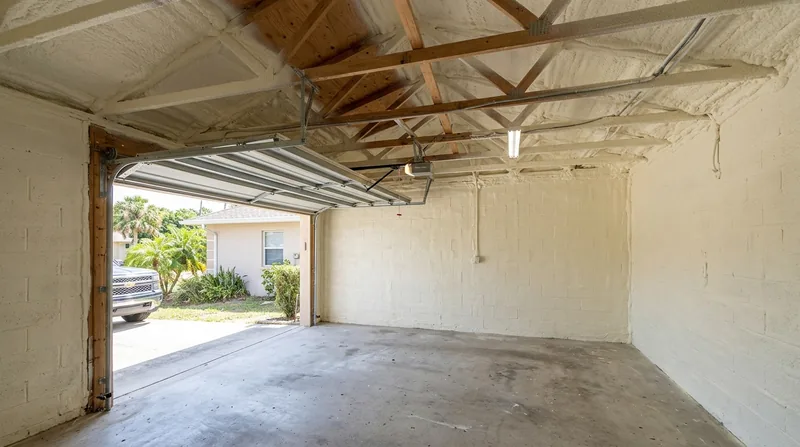




Garages in Palm Bay's concrete block homes become unbearable storage and workshop spaces once the afternoon sun hits the door, pushing interior temperatures well past 100 degrees Fahrenheit during the May-through-September cooling season. The block walls and flat ceilings trap radiant heat fast, and uninsulated garage doors allow that heat straight through into the living space beyond. Garage spray foam insulation in Palm Bay stops that heat transfer at the source, sealing the walls, ceiling, and garage door frame so your workshop stays usable and your air conditioning does not have to fight a furnace on the other side of a thin wall. We have been installing spray foam insulation across the Space Coast since 2015, and we understand exactly how Palm Bay's slab-on-grade block construction and high-humidity climate demand air sealing that actually works. A properly foamed garage keeps conditioned air in your home and unconditioned heat out of it.
Why Garage Spray Foam Insulation Matters in Palm Bay's Climate
Palm Bay's residential stock is overwhelmingly single-story concrete block on slab, a layout that became standard across the Port Malabar grid starting in the 1960s. This construction type is efficient for the slab itself, but it concentrates ductwork and air handlers in vented attics and leaves garage walls and ceilings exposed to the full heat load of Florida's climate zone 2A. Vapor drive runs from the outside toward the air-conditioned interior almost year-round, and any gap in the garage envelope pulls moist air and heat straight into the conditioned space. Spray foam stops that leak by creating an unbroken thermal and moisture barrier on every surface it touches.
- Reduces the cooling load on your air handler by blocking radiant heat from the garage into adjacent living spaces.
- Seals air leaks around the garage door frame, top plate penetrations, and soffits where humid outside air enters the garage and then the home.
- Maintains a stable garage temperature so workshop equipment and stored items do not degrade from heat cycling and humidity swings.
- Lowers your energy bill during the nine-month cooling season when air conditioning runs nearly every day.
- Improves comfort in rooms adjacent to the garage, which no longer feel like they are radiating heat from a furnace.
Homeowners who skip garage insulation often find that their cooling costs stay high even after upgrading their attic, because the garage has become the largest uncontrolled thermal leak in the house.
Key info: A typical attached garage in a Palm Bay block home can account for 15 to 25 percent of the total cooling load during summer months. Sealing it with spray foam often delivers faster payback than attic work alone, especially if your garage is directly beneath or adjacent to bedrooms or living areas.
For more on how spray foam works across all zones of your home, see our attic spray foam insulation page, which covers the same principles in the most common application.
How We Install Garage Spray Foam Insulation in Palm Bay
Garage insulation requires careful sequencing to get the thickness and coverage right without creating a safety hazard or trapping moisture. We start by inspecting the garage framing, roof deck, and door frame to identify any existing damage, moisture, or air leaks that must be sealed first. Once the substrate is clean and dry, we apply spray foam to the walls, ceiling, and garage door frame in controlled passes, maintaining the manufacturer ratio and drum temperature so the foam cures to its rated R-value without voids or compression. Mechanical ventilation runs during application and for the full cure window, typically 24 to 48 hours, to manage fumes and allow the foam to set properly.
- We inspect and document the current condition of the garage framing, roof deck, and door frame before any foam is applied.
- We seal air leaks and any moisture sources, or we walk away if the substrate is wet, contaminated, or actively leaking.
- We apply foam in controlled passes to achieve the specified R-value and thickness without over-spraying or creating thermal bridging.
- We run mechanical ventilation throughout application and cure so the space is safe to re-enter after 24 to 48 hours.
- We provide a written estimate that specifies the R-value, foam type, and thickness so you know exactly what you are paying for.
This methodical approach takes longer than a single-day spray-and-leave job, but it is the only way to guarantee the foam performs as designed and poses no safety risk to your household.
Example: A 400-square-foot attached garage in Melbourne with an uninsulated flat ceiling and single-thickness block walls typically takes two days from start to finish. Day one is substrate prep, air sealing, and the first foam application. Day two is final coverage, mechanical ventilation, and re-entry clearance. The homeowner can park in the garage and use the space normally 48 hours after we leave.
If your garage currently has failed insulation or you need it removed first, see our insulation removal service page for details on how we handle that precondition.
Garage Spray Foam Insulation Methods and Foam Types
| Foam Type | R-Value and Properties | Best for Garages |
|---|---|---|
| Closed Cell Spray Foam | R-6.5 to R-7 per inch, moisture and vapor barrier, rigid and durable. | Garages with high humidity or moisture risk, attached garages where thermal and air sealing must be absolute, or where structural support is needed. |
| Open Cell Spray Foam | R-3.5 to R-3.8 per inch, softer and more flexible, allows vapor transmission. | Detached garages or workshops where cost is a primary driver and moisture control is secondary, or where sound dampening is desired. |
| Closed Cell with Thermal Barrier | Closed cell foam plus a fifteen-minute thermal barrier coating to meet code ignition requirements. | Attached garages in Palm Bay and surrounding areas where the building code requires a thermal barrier between the foam and the garage interior. |
| Partial Foam Plus Air Sealing | Closed cell foam on ceiling and top plate only, with caulk and sealant on walls and penetrations. | Garages where the budget is tight but the goal is to stop heat transfer and air leaks into the home, not to fully insulate the space. |
The choice between closed and open cell depends on whether your garage is attached or detached, your moisture profile, and your budget. In Palm Bay's high-humidity climate, closed cell spray foam is the most common choice for attached garages because it serves as both insulation and a moisture barrier. For detached workshops or storage buildings, open cell offers lower cost and adequate thermal performance if moisture is not a concern. We provide a written estimate that specifies the foam type, R-value, and thickness so you understand the trade-offs before we spray.
Garage Spray Foam Insulation Cost in Palm Bay: What to Expect
Garage spray foam insulation in Palm Bay typically starts at $1,200 for a small detached garage or a partial foam job on an attached garage, and ranges up to $3,500 to $5,000 for a full 400-to-600-square-foot attached garage with closed cell foam, thermal barrier, and complete air sealing. The primary factors that move the price are the garage size, the foam type (open cell costs less than closed cell), the R-value target, and the complexity of the framing or roof deck. Access, existing insulation removal, and substrate prep also affect the final number. A free written estimate from us will specify the R-value, thickness, foam type, and total square footage so you know exactly what you are paying for and why.
Most homeowners in Palm Bay who insulate an attached garage see the investment pay for itself within three to five years through lower cooling bills during the nine-month cooling season. The payback is faster if the garage is directly beneath a bedroom or living room, where heat transfer has the biggest impact on comfort and air conditioning runtime.
We recommend getting estimates from at least two other contractors so you can compare the R-value, thickness, and foam type being offered at each price point. Avoid any estimate that does not specify R-value and thickness, or that promises immediate re-entry without mechanical ventilation during cure. For a detailed pricing breakdown and examples, see our full pricing page.
What to Look for When Hiring a Garage Spray Foam Insulation Contractor Near Palm Bay
The spray foam insulation trade has two distinct operator types in the Space Coast: local independent shops with a local address and local plates, and out-of-state rig-and-run crews that spray a job in an afternoon and leave no way to reach them if problems arise. You should verify any contractor's insurance coverage, ask for references from recent jobs in your area, and request a written estimate that specifies R-value, thickness, foam type, and the re-entry window. Do not accept a price-per-board-foot quote without a site inspection, and do not hire anyone who promises immediate re-entry or skips mechanical ventilation during cure.
- Confirm that the contractor carries current liability and workers compensation insurance, and ask to see a certificate of insurance.
- Request at least three references from garage or attic spray foam jobs completed in Palm Bay, West Melbourne, or Melbourne within the past two years.
- Obtain a written estimate that lists the foam type (open or closed cell), R-value per inch, total thickness, square footage, and the re-entry window after cure.
- Verify that the contractor uses mechanical ventilation during application and for the full cure period, typically 24 to 48 hours.
- Ask about any thermal barrier or ignition barrier coating required by your city, and confirm it is included in the estimate.
- Check whether your HOA or local building department requires a permit for garage insulation, and confirm the contractor understands the rules at your address.
The cheapest estimate is rarely the best one, especially if it comes without R-value specs, references, or proof of insurance. The strongest contractor is the one who asks questions about your garage layout, moisture history, and goals before writing a price.
When you are ready to get started, contact us for a free estimate. We will inspect your garage, explain your options, and provide a written quote with full specifications and no obligation to book.
Garage Spray Foam Insulation in Palm Bay: Pricing Guide
| Service | Price | Details |
|---|---|---|
| Small detached garage or partial foam job | Starting at $1,200 | Open cell foam on ceiling and top plate, or closed cell on high-priority areas only, typically 200-300 square feet. |
| Standard attached garage, full insulation | Starting at $2,400 | Closed cell foam on walls, ceiling, and garage door frame, 400-500 square feet, includes thermal barrier if code requires it. |
| Large or complex garage with air sealing | Starting at $3,800 | Closed cell foam plus caulk and sealant on all penetrations, substrate prep, and removal of failed insulation, 600+ square feet. |
| Existing insulation removal and replacement | On estimate | Tear-out of old fiberglass or failed foam, substrate inspection, and new spray foam installation require an on-site assessment. |
| Travel and setup | Included | No separate mileage fee or travel charge for jobs in Palm Bay and all surrounding Brevard County service areas. |
| Free written estimate | No charge | Response within 24 hours at (321) 341-3084, includes R-value, thickness, foam type, and total square footage, no obligation. |
Indicative pricing, the exact cost depends on square footage, finish, and site access. Free personalized estimate within 24h at (321) 341-3084.


