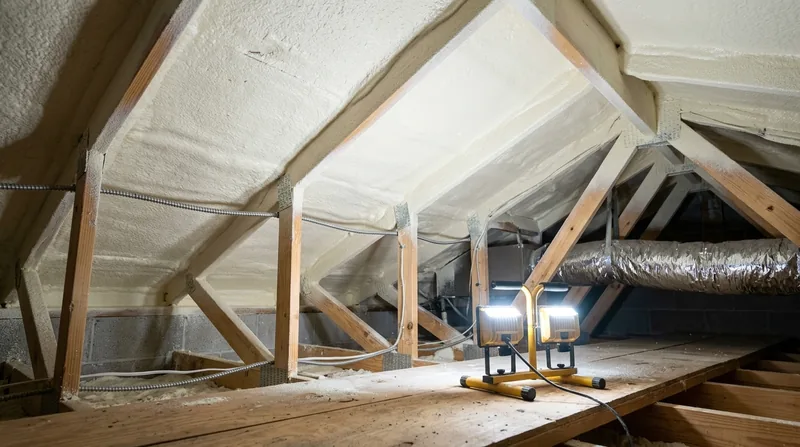




Palm Bay's housing stock is overwhelmingly single-story concrete block on slab, with vented attics that trap heat year-round in Florida's climate zone 2A. These attics house ductwork and air handlers that pull cooled air through penetrations, gaps around top plates, and failed insulation, sending cooling loads and humidity directly into living spaces. When old insulation degrades, settles, or was never adequate to begin with, the summer electric bill climbs faster than the attic temperature. Insulation replacement and re-insulation in Palm Bay restores the thermal and air-sealing envelope that stops that heat and humidity at the attic floor, not in your home. We remove failed insulation, seal air leaks at their source, and install closed or open cell spray foam sized to the cooling load that dominates the Space Coast nine months a year. The result is a measurable drop in utility bills and a home that stays comfortable without fighting the thermostat.
Why Insulation Replacement Matters in Palm Bay's Heat-Driven Climate
Palm Bay sits in the heart of Brevard County's Port Malabar grid, where homes built from the 1960s onward were laid out on slab foundations with vented attics. These attics were never designed to handle the sustained cooling load of a humid subtropical climate where air conditioning runs nearly year-round. Old blown-in fiberglass insulation settles, compacts, and loses R-value over decades. Cellulose absorbs moisture in Florida's high-humidity environment and becomes a thermal and air-sealing liability. Batts leave gaps around ducts, wiring, and penetrations that leak conditioned air directly into the unconditioned attic. When insulation fails, the cooling load climbs, and the utility bill follows the attic temperature upward.
- Old insulation settles and compacts, losing R-value and thermal performance over time.
- Gaps and voids around ductwork, electrical penetrations, and top plates allow conditioned air to escape into the attic.
- Moisture absorption in humid climates reduces insulation effectiveness and invites condensation on the attic floor.
- A properly sealed and insulated attic floor stops the cooling load at the boundary, not inside your home.
Replacing failed insulation with spray foam and proper air sealing is the most direct way to recover the thermal envelope that your air conditioner depends on.
Key info: A Palm Bay home with a 1,500 square foot attic and old, settled fiberglass insulation at R-19 or lower is losing cooled air through the attic floor continuously. Replacing that insulation with closed cell spray foam at R-24 to R-30 stops that leak and typically recovers 15 to 30 percent of the cooling load, depending on existing air sealing and duct condition.
For more detail on how spray foam handles the moisture and heat load specific to vented attics, visit our attic spray foam insulation page.
How Insulation Replacement and Re-Insulation Works in Palm Bay
The process starts with removing the old, failed insulation. We pull out settled fiberglass, matted cellulose, or degraded foam, haul it away, and dispose of it properly. Once the attic floor is bare, we identify and seal air leaks at the source: gaps around the top plate where the wall meets the attic, penetrations for electrical and mechanical lines, duct boots, and soffit vents that allow air movement. Then we install new spray foam, either closed cell for maximum R-value and moisture control, or open cell for a lower cost and sound dampening. We size the foam to the cooling load and specify the thickness and R-value in writing before we spray.
- We remove all old insulation and haul it away, leaving the attic floor clean and bare.
- We locate and seal air leaks at ductwork, electrical penetrations, top plates, and soffit vents with foam or caulk.
- We spray closed cell or open cell foam to the specified thickness, measured and documented on site.
- We provide a written estimate with R-value, thickness, and coverage area before any work begins.
The entire process takes one to two days, depending on attic size and the complexity of air sealing required. During spray, mechanical ventilation runs to manage fumes, and we specify a re-entry window of twenty-four to forty-eight hours before the space is safe for occupancy.
Example: A West Melbourne home with a 1,200 square foot attic and old, matted fiberglass at R-11 gets a complete removal, air sealing around the top plate and ductwork, and 4.5 inches of closed cell spray foam (R-24). The job takes one full day, the attic is re-entry ready within forty-eight hours, and the cooling load drops measurably because the conditioned air now stays inside the home, not leaking into the unconditioned attic.
For details on how we handle the air sealing that makes insulation work, see our air sealing page.
Insulation Replacement Methods: Closed Cell vs. Open Cell
| Approach | Description | Best for |
|---|---|---|
| Closed Cell Spray Foam | High-density foam with closed air pockets, R-6 to R-7 per inch, impermeable to moisture, acts as vapor barrier and air seal in one pass. | Vented attics in humid climates, maximum thermal performance, moisture control, and air sealing in one application. |
| Open Cell Spray Foam | Lower-density foam with open air pockets, R-3.5 per inch, permeable to moisture, requires a separate vapor barrier, lighter feel and sound dampening. | Attics where cost is primary, sound control is desired, or where moisture permeability is acceptable under a proper vapor barrier. |
| Removal and Replacement with Blown-In | Old insulation removed, attic floor re-insulated with blown fiberglass or cellulose at specified R-value, no foam. | Budget-conscious replacement where air sealing is minimal, existing attic floor is sound, and maximum R-value per dollar is the goal. |
| Hybrid: Foam Air Sealing Plus Blown-In Top-Up | Spray foam applied to seal gaps and penetrations, then blown insulation added on top to reach target R-value at lower cost. | Existing attic with some sound insulation that needs air sealing and modest R-value improvement without full foam replacement. |
Insulation Replacement and Re-Insulation Cost in Palm Bay: What to Expect
Insulation replacement cost in Palm Bay starts at $2,800 for a small attic with straightforward removal and open cell foam installation. The final price depends on several concrete factors: attic size (measured in square feet), the type and depth of old insulation being removed, the amount of air sealing required (ductwork, top plates, electrical penetrations), and whether you choose closed cell or open cell foam. A 1,500 square foot attic with heavy old fiberglass, significant ductwork, and closed cell foam will cost more than a 900 square foot space with light cellulose and open cell. Getting two or three written estimates from different contractors is always smart, because each will evaluate air sealing needs and foam type differently based on your specific attic and cooling load.
- Attic size is the primary cost driver: larger attics require more material and labor time.
- Removal complexity affects cost: heavy, compacted fiberglass takes longer to haul out than light cellulose.
- Air sealing scope varies: extensive ductwork and top plate sealing adds labor and material.
- Foam type matters: closed cell costs more per board foot than open cell but delivers higher R-value and moisture control.
- Two or three estimates give you confidence in the market price and allow you to compare scope, not just the bottom line.
For a detailed breakdown of what moves the price up or down, visit our full pricing page.
What to Look for When Hiring an Insulation Contractor Near Palm Bay
When you call a spray foam contractor for an estimate, you are evaluating not just price but the quality of the work and the honesty of the estimate itself. A good contractor walks the attic with you, measures the space, identifies air sealing needs, and hands you a written estimate that specifies R-value, foam thickness, coverage area, and the removal scope. A bad contractor gives you a price over the phone with no site visit, promises immediate re-entry the day of the spray, or quotes a price so far below market that it signals corners being cut. Before you book, verify that the contractor carries full insurance, ask for references from recent jobs in your neighborhood, and understand what permits your city requires for the work. If you live in a planned community or HOA, check whether exterior work or attic venting changes need architectural approval. Get the estimate in writing, ask what happens if the substrate is wet or contaminated, and confirm the re-entry window and any workmanship warranty.
- Request a site visit and a written estimate that specifies R-value, thickness, and coverage area before booking.
- Verify that the contractor carries full insurance and can provide a certificate on request.
- Ask for references from recent jobs in Palm Bay, West Melbourne, or Melbourne and call them.
- Confirm what permits apply at your address by checking with your local building department.
- Ask about the re-entry window, any workmanship warranty, and what the contractor does if the attic is wet or contaminated.
For a free, no-obligation estimate from a local contractor who walks your attic and puts the scope in writing, call contact us at (321) 341-3084.
Insulation Replacement & Re-Insulation in Palm Bay: Pricing Guide
| Service | Price | Details |
|---|---|---|
| Small attic with removal and open cell foam | Starting at $2,800 | Removal, air sealing, and open cell spray foam for attics under 1,000 square feet |
| Medium attic with removal and closed cell foam | Starting at $4,200 | Removal, top plate and ductwork sealing, closed cell spray foam for 1,000 to 1,500 square foot attics |
| Large attic or complex air sealing | On estimate | Attics over 1,500 square feet or requiring extensive duct sealing, soffit venting, or electrical penetration work need on-site evaluation |
| Removal only (blown-in top-up alternative) | Starting at $1,200 | Old insulation removal and haul-away, allowing homeowner to add blown fiberglass or cellulose separately |
| Travel and estimate | Included and free | No mileage fee in Palm Bay and surrounding areas, free written estimate with no obligation to book |
Indicative pricing, the exact cost depends on square footage, finish, and site access. Free personalized estimate within 24h at (321) 341-3084.


