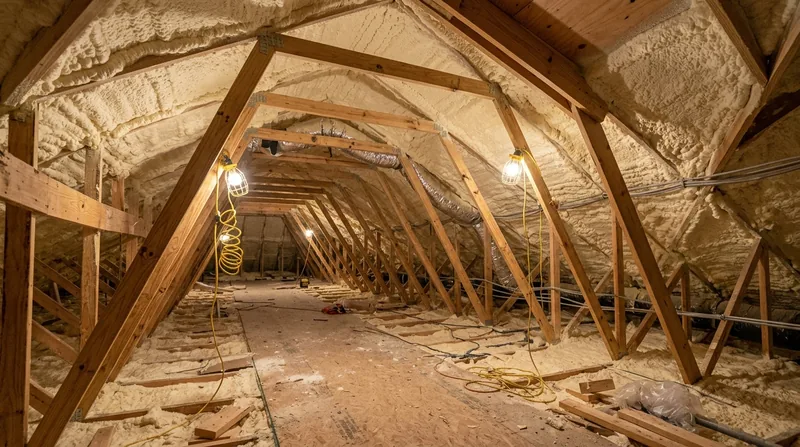




Open Cell Spray Foam Insulation in Palm Bay fills the vented attics that dominate the Space Coast's single-story concrete block homes, sealing the gaps where humid Florida air leaks toward your air-conditioned living space. Palm Bay's residential grid, laid out across Port Malabar from the 1960s onward, sits in climate zone 2A, a hot and humid cooling-dominated zone where air conditioning runs nearly year-round and summer electric bills follow attic temperature upward. The block construction, slab-on-grade foundation, and vented attic layout that characterize homes in Palm Bay, West Melbourne, and Melbourne create a vapor-drive problem unique to the Space Coast: moisture from outside moves constantly toward the cooled interior, pulling humid air through every gap in the attic floor, around ductwork, and through penetrations at the top plate and soffits. Open cell foam expands to fill those voids, seals the air leakage, and reduces the cooling load that dominates your utility bill. This guide explains how open cell works in Palm Bay homes, what to expect during installation, and how to find the right contractor for your attic.
Why Open Cell Spray Foam Insulation Matters in Palm Bay's Hot, Humid Climate
Palm Bay's climate and building stock create a specific insulation challenge: vented attics with ductwork and air handlers sitting above slab-on-grade homes in a cooling-dominated zone. The attic temperature in summer can exceed 140 degrees Fahrenheit, and because the attic is vented to the outside, humid air moves continuously from the hot exterior toward the cooled living space below. Every gap in the attic floor, every duct boot, every electrical penetration at the top plate becomes a pathway for that humid air to reach your air-conditioned rooms. Fiberglass batts do not stop air movement, so homeowners in Palm Bay, Melbourne, and Satellite Beach often find that their cooling costs stay high even after adding more insulation. Open cell foam seals those air leaks while also providing insulation value, so it cuts both the conduction loss and the infiltration loss that drive your summer cooling bill.
- Seals air leaks around ductwork, electrical penetrations, and top plate gaps that fiberglass cannot address.
- Reduces the cooling load by preventing humid outside air from infiltrating toward your air-conditioned rooms.
- Expands to fill voids and irregular cavities in older block homes where standard batts leave gaps.
- Provides sound dampening, which is a secondary benefit in attics but valued by homeowners seeking quieter living spaces.
- Works in the vented attic configuration that dominates Port Malabar without requiring attic ventilation changes.
These air sealing and insulation benefits combine to lower your cooling costs and improve comfort during Palm Bay's long cooling season.
Key info: Palm Bay's vented attic homes sit in a vapor-drive zone where humid outside air moves constantly toward your cooled interior. Open cell foam seals the air leakage pathways that fiberglass misses, cutting both conduction and infiltration losses. This is why open cell has become the standard retrofit choice for attics across Port Malabar and Bayside Lakes.
For more on how attic insulation works in your climate, see our guide to Attic Spray Foam Insulation in Palm Bay.
How Open Cell Spray Foam Installation Works in Palm Bay Homes
Open cell spray foam installation in a Palm Bay attic follows a straightforward process: the crew accesses your attic, prepares the substrate, applies the foam in layers to the specified thickness and R-value, and allows it to cure before re-entry. The foam expands as it is sprayed, filling every void and sealing air leaks around ductwork, electrical boxes, and top plate penetrations. Because open cell has a lower density than closed cell, it is lighter, less expensive per board foot, and easier to apply in residential attics where access and headroom are tight. The installation crew uses mechanical ventilation during the cure period to manage off-gassing, and the standard re-entry window is twenty-four to forty-eight hours after the last pass. Once cured, the foam is trimmed flush to the top of the rafters, and a thermal barrier is applied per Florida building code.
- We inspect your attic, measure thickness and R-value requirements, and identify air leakage pathways around ductwork, electrical penetrations, and the top plate.
- We prepare the substrate by clearing debris and ensuring the surface is dry before spraying begins.
- We apply open cell foam in layers to the specified thickness, typically 5 to 6 inches for an R-20 to R-24 value in attics.
- We run mechanical ventilation during cure to manage off-gassing and ensure proper curing conditions.
- After twenty-four to forty-eight hours, we trim the foam flush to the rafter face and install the thermal barrier required by code.
- We conduct a final walkthrough to confirm coverage, thickness, and seal quality before we hand the job back to you.
This process seals the air leakage that fiberglass cannot address while providing the insulation value your Palm Bay home needs.
Example: A 1,200-square-foot attic in a Bayside Lakes home with existing fiberglass batts, ductwork running through the floor, and a 140-degree summer temperature typically receives 5 inches of open cell foam for an R-20 value plus air sealing. The job takes one to two days, and the homeowner sees cooling cost reductions of 15 to 25 percent in the first summer after installation.
For details on how we handle attic preparation and substrate issues, visit our page on Insulation Removal in Palm Bay.
Open Cell vs. Closed Cell Spray Foam: Which is Right for Your Palm Bay Attic?
Open cell and closed cell spray foam serve different purposes, and the choice depends on your attic use case. Open cell foam is less dense, lower cost per board foot, and excellent for attics where air sealing is the primary goal and the space will remain vented. Closed cell foam is denser, provides a higher R-value per inch, and includes a vapor barrier, making it the choice for unvented attics, crawl spaces, and metal buildings where condensation control is critical. In Palm Bay's vented attics, open cell is typically the right answer because you are sealing air leaks in a space that remains open to the outside, and the lower cost per board foot delivers strong ROI on cooling savings. Closed cell is specified when the goal is to create a sealed, conditioned attic (a significant project involving roof deck spraying and ventilation changes) or when you are insulating a metal building or crawl space where condensation risk is high.
| Approach | Description | Best for |
|---|---|---|
| Open Cell Spray Foam | Lower density, expands fully, R-3.5 to R-4 per inch, no vapor barrier, lighter weight. | Vented attics in Palm Bay homes, air sealing, sound dampening, retrofit projects where cost per board foot matters. |
| Closed Cell Spray Foam | Higher density, limited expansion, R-6 to R-7 per inch, includes vapor barrier, excellent moisture control. | Unvented attics, sealed roof decks, metal buildings, barndominiums, crawl spaces, condensation-prone applications. |
| Blown-In Fiberglass or Cellulose | Loose-fill insulation, no air sealing, R-3.2 to R-3.8 per inch, does not address infiltration. | Top-up of existing fiberglass in attics where air leakage is not a concern and budget is the primary driver. |
| Fiberglass Batts | Standard insulation, conduction value only, no air sealing, susceptible to settling and moisture in humid climates. | New construction where framing is tight and air sealing is handled by other means, or budget attics where vapor drive is not a concern. |
For a detailed comparison and to understand whether closed cell or open cell is right for your project, see our guide to Closed Cell Spray Foam Insulation in Palm Bay.
Open Cell Spray Foam Insulation Cost in Palm Bay: What to Expect
Open cell spray foam in Palm Bay typically costs from $0.55 per board foot, though the final price depends on several factors specific to your home and attic. The board footage is measured on site based on the thickness and R-value needed for your attic, so two homes of the same square footage may have different costs if one requires thicker application due to higher cooling loads or larger ductwork that needs sealing. Access to your attic, the condition of the existing insulation (whether it needs removal), the height of the roof peak, and the complexity of the layout all affect the labor time and material usage. A typical 1,200-square-foot attic in a Port Malabar home might use 1,500 to 2,000 board feet of open cell for a 5-inch, R-20 application, putting the material cost in the range of $825 to $1,100 before labor and the thermal barrier. Adding labor and materials, a complete open cell attic job in Palm Bay typically runs $1,500 to $3,500 depending on the attic size and existing conditions.
The best way to understand what your specific attic will cost is to request a free written estimate that includes the R-value, thickness, and board footage calculated for your home. We provide estimates with all specifications included, so you can compare accurately to any other quote. Avoid estimates with no thickness or R-value specified, no insurance verification, or prices far below market, as these are signals of inexperienced or uninsured work. For detailed pricing on various attic sizes and configurations, visit our Pricing Overview.
What to Look for When Hiring a Spray Foam Insulation Contractor Near Palm Bay
Finding the right spray foam contractor near Palm Bay is about verifying three things: full insurance coverage, a clear written estimate with R-value and thickness specifications, and a track record of proper installation technique. The spray foam industry includes both local independent shops and national franchises, and it also includes rig-and-run crews that spray a job in an afternoon and disappear when the smell will not go away or when questions arise weeks later. The honest contractor provides a written estimate that specifies the R-value, thickness, and board footage for your attic, uses mechanical ventilation during cure, states a realistic re-entry window of twenty-four to forty-eight hours, and carries insurance that you can verify by name and policy number. Permitting varies by city across Greater Palm Bay and surrounding areas, so ask your contractor to explain what applies at your address and to help you understand whether your city or HOA requires permits for attic insulation work.
- Verify that the contractor is fully insured and ask for a certificate of insurance naming your address as additional insured.
- Request a written estimate that includes R-value, thickness in inches, and total board footage, not just a price per square foot of attic.
- Ask whether the contractor will use mechanical ventilation during cure and what the realistic re-entry window is for your home.
- Check references from recent jobs in Palm Bay, Melbourne, or West Melbourne, and ask about the contractor's response if questions came up after installation.
- Confirm that the contractor understands permitting requirements for your specific city and will help navigate what your local building department requires.
- Avoid estimates with no specifications, prices far below market, or promises of immediate re-entry, as these are markers of inexperienced or uninsured work.
When you are ready to move forward, contact us for a free estimate and we will walk you through every step of the process.
Open Cell Spray Foam Insulation in Palm Bay: Pricing Guide
| Service | Price | Details |
|---|---|---|
| Open Cell Spray Foam, Attic Application | Starting at $0.55/board ft | Material cost for open cell foam; final price depends on attic size, thickness, and R-value needed for cooling load |
| Typical 1,200 sq ft Attic, R-20 (5 inches) | Starting at $1,500 | Includes open cell foam, labor, mechanical ventilation during cure, thermal barrier, and final inspection and cleanup |
| Attic with Existing Insulation Removal | On estimate | Add labor and disposal cost if old fiberglass or cellulose must be removed before foam application; price depends on volume |
| Complex or Large Attic (2,000+ sq ft or High Peak) | On estimate | Larger jobs or high-peak roofs require on-site measurement and access assessment before a firm price can be quoted |
| Travel and Free Estimate | Included | No separate mileage fee in Palm Bay and surrounding service areas; free written estimate within 24 hours at (321) 341-3084 |
Indicative pricing, the exact cost depends on square footage, finish, and site access. Free personalized estimate within 24h at (321) 341-3084.


